Most new blogs don't make it past their first year. They don't fail because the writer ran out of ideas. Blogs fail because the writer ran out of energy.
Blogging looks light from the outside. In reality, it's a long game, and it only turns into anything resembling passive income after years of consistent publishing, a solid base of evergreen content, and real authority in your niche.
Why most new blogs go quiet
Let's be honest. Most bloggers want something out of it, whether that's some beer money or a slow path to working fewer hours at their 9-to-5. Nothing wrong with that. The problem is how they try to get there.
Read also: Why most bloggers quit at month 3 (and how to build one that lasts)
The most common pattern I see is a new blogger going 100 miles per hour from day one, then quietly disappearing a few months later. And search isn't getting kinder. With AI answers sitting on top of results, a decent post can slide from page one to page three and never get seen.
I made this mistake more than once. I wrote like a maniac, published four times a week, and then the passion wore off. I started procrastinating, went from four posts a week to zero, and ended up with an abandoned blog.
Consistency doesn't mean publishing every day
This is where most people get it wrong. Consistency isn't a daily streak. It's showing up over a long enough period for the work to compound.
Consistency means continuing to publish over months and years
Missing a day, or a week, doesn't destroy the habit
A 300-day streak sounds impressive, but publishing regularly for five years means a lot more
Long-term consistency is about returning, not about stopping
Think in months, not streaks. The goal is still being here next year.
Build a buffer before you announce anything
The advice "write and publish" has some truth to it. But before you launch a new blog or promise a schedule, write a buffer first.
Write at least 5 to 10 posts before your first one goes live
Aim for a 3- to 4-week safety net at all times
Keep writing after launch, so the buffer refills faster than it drains
Without a buffer, you feel the pressure every single week because there's nothing ready to go. You start writing out of necessity, and that's where quality drops. A buffer means you're never writing against a same-day deadline.
Read also: How to stop overthinking and publish your first blog post
Start slow and scale up later
Once you have your buffer, pick a baseline cadence. Once a week works for most people. If you're busy, once every two weeks is completely fine.
It won't stay this way forever. The point is to learn what it takes to move a post from draft to published and organized, before you commit to more. Only scale up when your idea backlog and your buffer are both naturally overflowing.
Also accept this early: most of your first posts won't be great. It takes time to find your voice so your blog doesn't read like every other blog in your niche.
Nobody reads a blog with three posts anyway, so focus on how each post connects to the next and slowly builds a story.
Stop trying to come up with things to write
This is the idea the whole approach rests on. The most reliable way to stay consistent is to stop treating blogging as something you have to constantly invent, and start treating it as a record of what you're already doing.
Separate writing from having something to say. Don't manufacture topics. Write when something happens, changes, annoys you, teaches you something, or makes you think.
Building something? Write about it
Tried a platform? Write about it
Changed your mind? Write about why
Failed at something? That's a post too
Your own life becomes the editorial calendar. When you're stuck, ask yourself:
What did I build?
What did I try?
What changed?
What frustrated me?
What did I learn?
What am I thinking about right now?
This removes most of the "what should I write about" pressure in one move.
Keep a backlog of ideas
You don't need a polished content plan. One sentence in your notes app is enough to capture an idea before it's gone.
Don't turn every idea into a full article the moment you have it. Let the backlog grow, and pull from it when you sit down to write. A healthy backlog is also your signal for when it's safe to publish more often.
Not every post needs the same energy
Not every post has to be a 2,000-word masterpiece. A 30-minute post is still a real post, and some of your most useful writing will come from things you were already doing anyway.
Mix up your levels of effort:
A 20-minute post
A 45-minute post
A deep dive
A personal reflection
A quick observation
A curated roundup of things you found useful
Give each post one goal and keep the scope tight. One post, one idea. It stops you from overthinking and stops a simple post from ballooning into a week of work.
Read also: Long-form vs. short-form blogging: What should you focus on?
And don't confuse volume with quality. Publishing often doesn't mean every post needs to feel important. Some posts are snapshots of where you were at that moment, and that's enough.
Split the work into separate sessions
Trying to go from blank page to finished article in one sitting is one of the fastest ways to burn out. Break it up instead:
An ideation session to pick the topic and outline it
A drafting session to get it written
An editing session, ideally on a different day, with fresh eyes
I keep my outline and notes open on one side and the draft on the other while I write, which is a big part of why I built TWO around a split view.
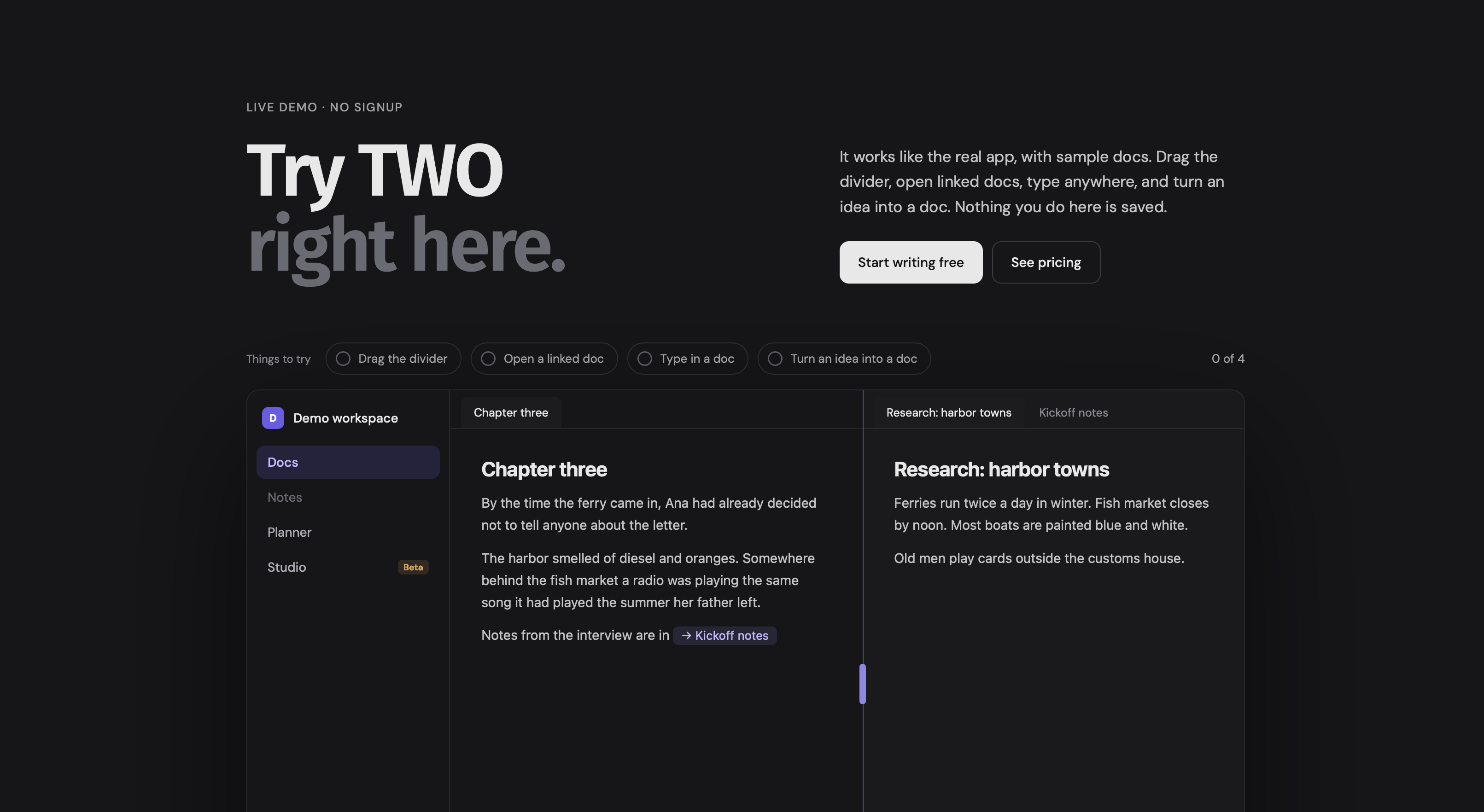
Whatever setup you use, the point is to stop switching between tabs and windows every few minutes.
A note on AI while we're here:
Plenty of new writers think AI will let them publish at double the pace. Use it to assist your writing, not to write it for you. Every post still needs your editing, your voice, and a workflow that takes it from A to Z.
Read also: How to write blog posts AI can't fake
Keep writing time and distribution time apart
Promotion, social posts for Pinterest, and newsletters are important. But if you do them in the same session as writing, marketing will drain the energy you need to write the next post.
Set clear boundaries. Write on writing days, distribute on distribution days.
Same goes for SEO. If every post requires keyword research, competitor analysis, perfect formatting, and a full SEO checklist, you'll eventually stop wanting to write. Your blog shouldn't become another job. It should still feel like yours.
Let your interests change
A personal blog doesn't need a perfectly consistent niche. If you're into SaaS this week and language learning next week, that's part of the point.
Readers who stick around usually stick around for the person, not the keyword. Give yourself room to follow what you're curious about.
Know when to stop for the day
Sometimes the best way to stay consistent tomorrow is to stop writing today. Consistency isn't an endurance competition.
Protect the fun. If you look at your own blog and think "I have to produce another piece of content," something has gone wrong. You should still occasionally want to write because there's something you want to get out of your head.
Read also: The setup tax: why tool setup kills your writing
Your archive is the long-term asset
Don't obsess over immediate traffic. A post can sit there doing almost nothing for months, then quietly turn into a useful search result, a reference someone links to, or the post that brings in your best reader.
You're building an archive, not chasing today's numbers. Over time you'll be able to look back and see what you were building, thinking about, testing, and changing. No content calendar can manufacture that.
Final word
Write ahead, publish slower than you think you should, and document what you're already doing. The bloggers who win aren't the ones who started fastest. They're the ones who were still publishing five years later.