Every few months, someone declares niche blogging dead. Usually it's a blogger who watched their traffic disappear overnight and needs someone to blame. AI search is the easy target.
But the data tells a different story. Niche blogging isn't dying. Generic blogging is, and it probably should.
What happened?
For years, the playbook was simple. Find a keyword, write 1,500 words answering it, rank on Google, collect affiliate income. It worked so well that millions of people copied it, and eventually search engines were flooded with generic "what is" posts written by people with no real experience in the topic.
Generative AI made that problem worse before it made it better. Anyone could generate the same generic post in seconds, at scale, for free. The web filled up with thin, AI-written content chasing the same keywords.
Then Google's search updates caught up. Sites built on thin, low-effort content lost most of their traffic almost overnight. The bloggers running those sites are the ones now saying blogging is dead.
What really died was a specific kind of content: shallow, keyword-driven, written by nobody in particular. The point is what you write and who you're writing it for.
People still read blogs, a lot of them
Despite AI search, people haven't stopped reading blogs. If anything, the appetite for real, human-written perspective has gone up. So I dug in.
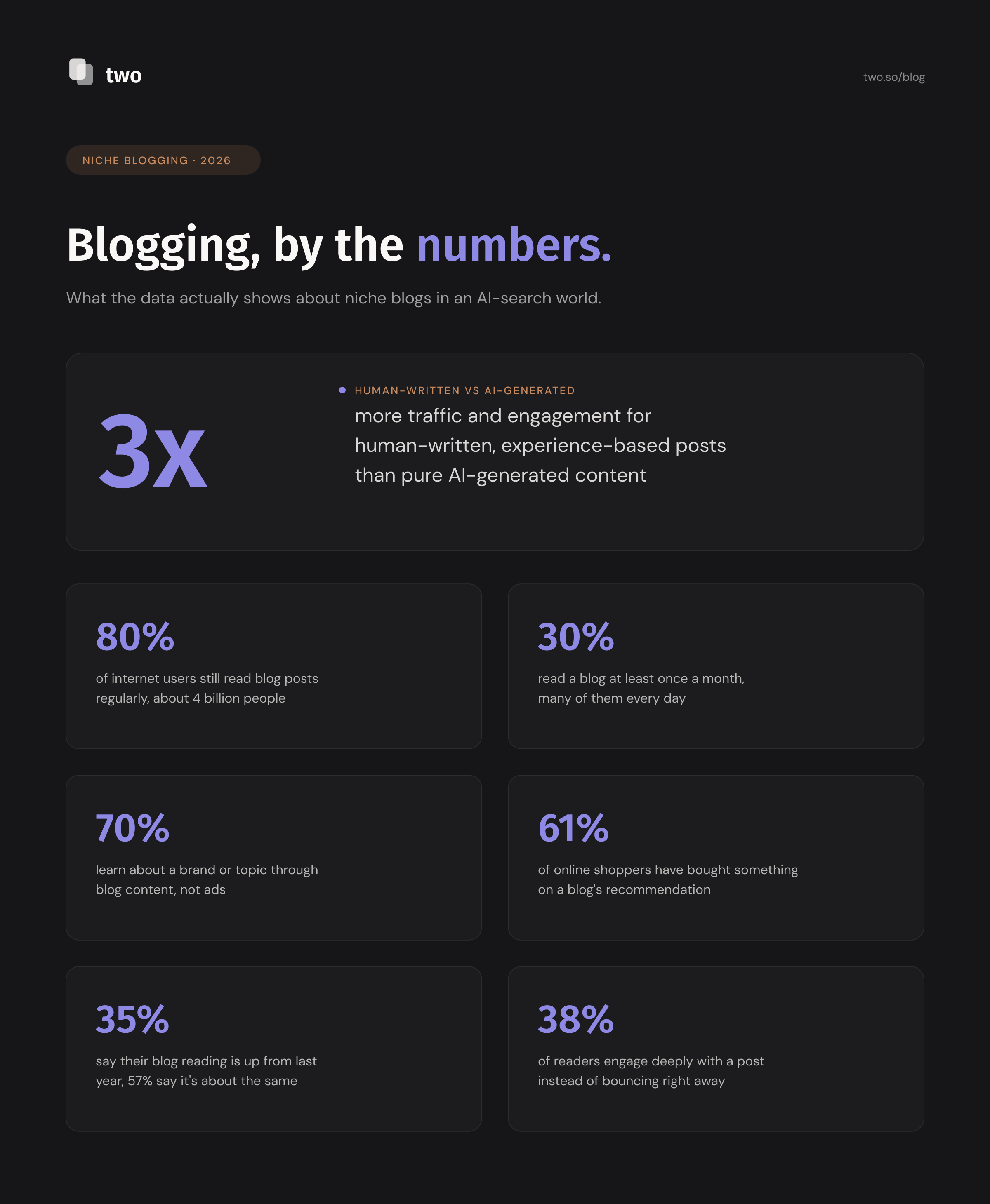
Around 80% of internet users still read blog posts regularly, roughly 4 billion people
About 30% read a blog at least once a month, many of them daily
35% say their blog reading has gone up compared to previous years; 57% say it's stayed the same
70% of people learn about a brand or topic through blog content rather than ads
61% of online shoppers have bought something based on a blog recommendation
Human-written, experience-based posts get roughly 3x the traffic and engagement of pure AI-generated ones
38% of readers engage deeply with blog content instead of bouncing immediately
If blogging were actually dead, none of these numbers would hold up.
Read also: How to start a blog in 2026: niche, planning, and AI
Why niche still wins
Readers are tired of generic AI answers. They're actively looking for first-person experience, honest opinions, and people who've done the thing they're writing about. That's the opposite of what a language model produces by default.
A few reasons niche blogging is in a stronger position than broad blogging ever was:
Specific problems still get searched. "How do I fix X" queries haven't gone anywhere.
Narrow niches face far less competition. Ranking for "productivity" is nearly impossible. Ranking for "productivity for solo founders" is realistic.
Expertise compounds. Fifty posts on one narrow subject build more authority than fifty posts on unrelated ones.
Personal experience is hard to copy. "I used this for six months and here's what happened" isn't something AI can fake.
Small, specific audiences monetize well. You don't need 500,000 visitors a month if 5,000 of them are exactly the right people.
AI models need sources. They cite well-structured, authoritative niche blogs as references, which is a new discovery channel, not a threat.
The bigger shift
The web is fragmenting. People find things through Reddit, YouTube, newsletters, communities, and AI assistants now, not just Google search. A blog you own isn't dependent on any one of those staying favorable to you.
That's the real argument for niche blogging in 2026. It's not about chasing the biggest audience possible.
It's about becoming genuinely useful to a specific group of people, on a domain you control, that no algorithm change can take away from you.
Final note
Niche blogging isn't dead. It just stopped being easy, and that's not the same thing. The bar moved from "can you write about a topic" to "do you really know what you're talking about."
For anyone willing to write from real experience instead of chasing keywords, that's a good trade.